Sparse-Constraint Continuum Threading
This experiment fits a continuous material-space transformation field from three gate poses and one tip pose. No target centerline or material-to-gate correspondence is supplied to the optimizer. A \(Cl(4,1)\) conformal model supplies an SE(3) generator subspace, while an RBF sampler varies those generators along the persistent material coordinate.
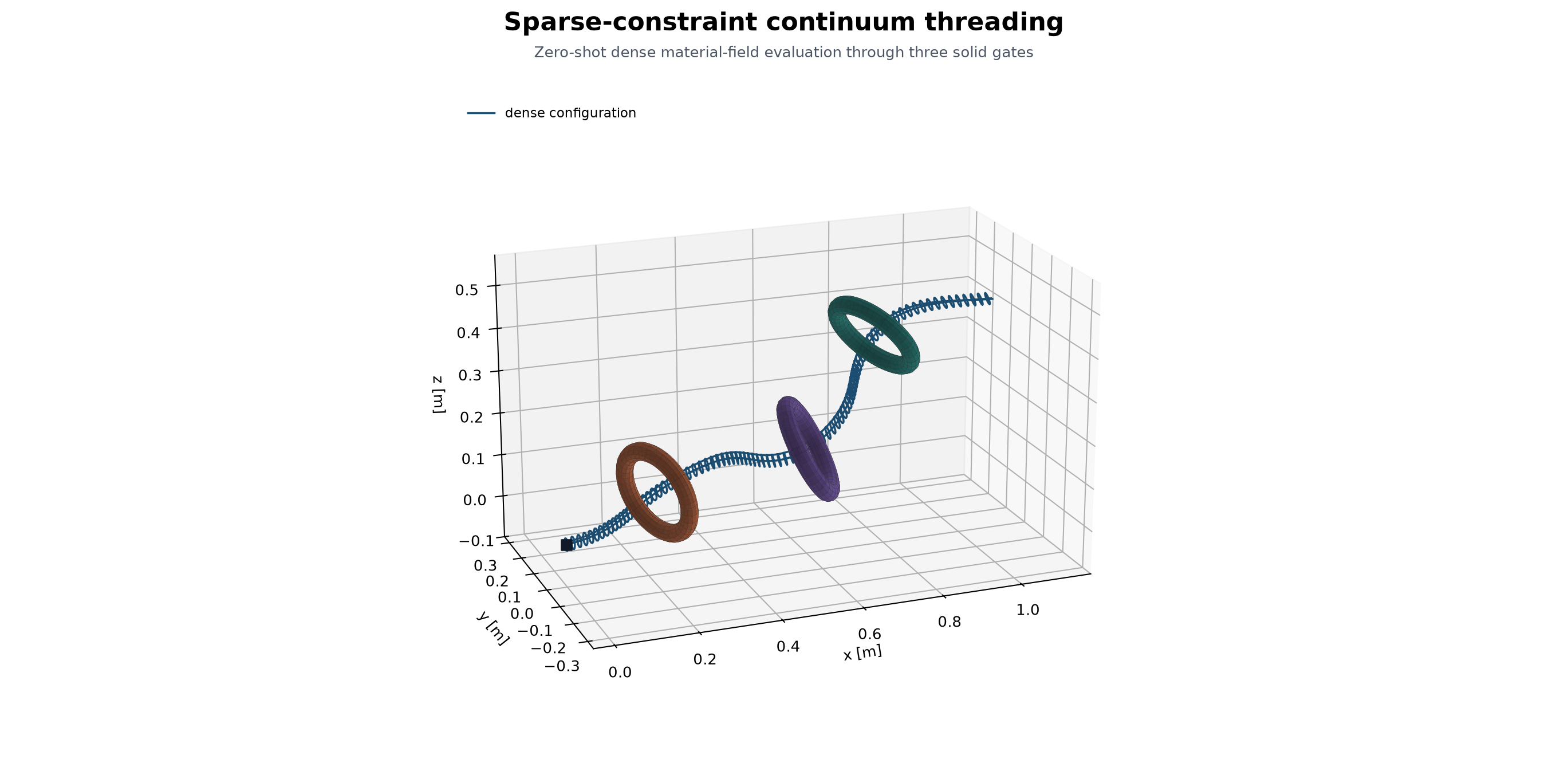
Experiment
The optimization uses a uniform material grid with 42 cross-sections and four surface samples each, 210 points in total. It does not snap samples to gates. The undeformed rod length is a fixed 1.483 m scene parameter. At each step, the current predicted centerline determines the first forward segment crossing each gate plane. Segment selection is detached, while the crossing point is interpolated differentiably within that segment. Ten ordered local actions deform the rod while losses enforce gate-center, gate-alignment, and tip constraints together with collision, strain, curvature, base, and smoothness terms.
After optimization, the same field parameters are evaluated directly on 180 cross-sections with twelve surface samples each: 2,340 points with no additional optimizer step.
The dense evaluation reports:
| Quantity | Result |
|---|---|
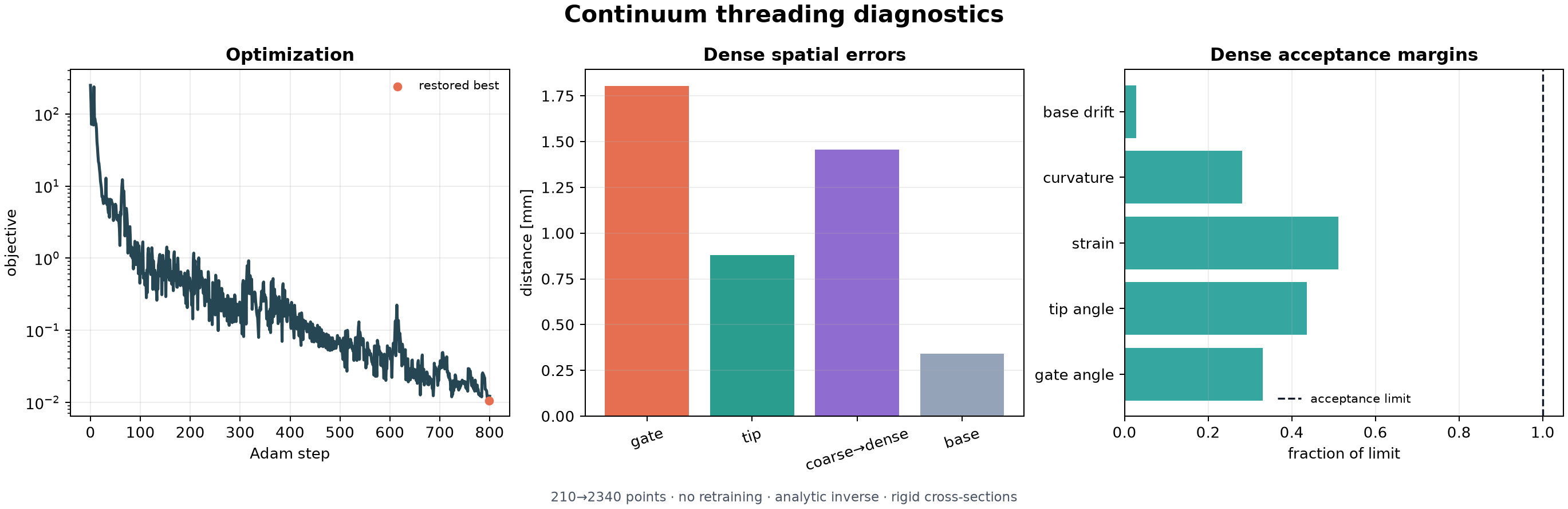
| Gate crossing center offset | 1.80 mm |
| Tip position error | 0.88 mm |
| Inferred gate material coordinates | 0.2195, 0.5322, 0.8036 |
| Coarse → dense centerline discrepancy | 1.46 mm |
| Minimum obstacle clearance | 65.1 mm |
| Maximum axial strain | 0.056 |
| Indexed inverse error | \(4.7\times10^{-15}\) |
| Cross-section rigidity error | \(7.6\times10^{-14}\) |
All acceptance checks pass for sparse threading, geometric validity, analytic inverse and rigidity, and zero-shot dense transfer. Threading requires genuine forward gate-plane crossings on both grids. Clearance and curvature are checked at sampled centerline sections, so they are not continuous-segment guarantees.
Recorded default run summary:
setup         3 gates + 1 tip pose | 14 RBF controls | 210 optimization points | seed 17
[   0/800] loss=2.488e+02 gate=0.5237 tip=0.6042 orient=159.5° clear=+0.0336 strain=0.010
[ 800/800] loss=1.215e-02 gate=0.0023 tip=0.0010 orient=6.3° clear=+0.0651 strain=0.054
primary      gate 0.0025 m | tip 0.0009 m | clearance +0.0654 m
validation   210→2340 points | gate 0.0018 m | transfer Δ 0.0015 m
gate s        0.2195, 0.5322, 0.8036
numerical    inverse 4.7e-15 | rigidity 7.6e-14 | strain 0.056
optimization best 1.064e-02 at 799 | final 1.215e-02
Run
Add --live for the interactive optimization view. The canonical saved
artifacts are written to outputs/sparse_continuum_threading/.