Relativistic Beamline Inverse Design
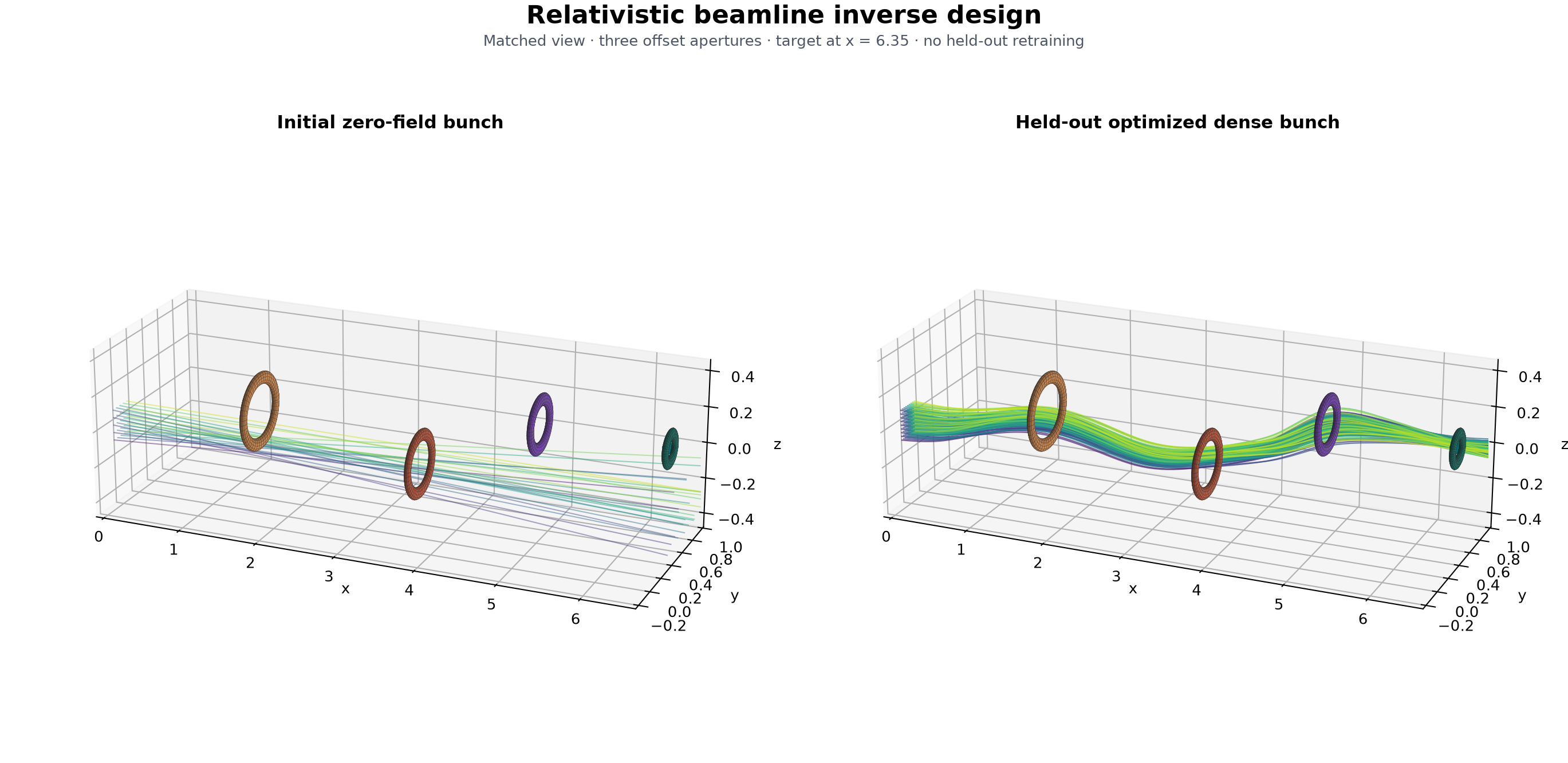
This experiment optimizes a spatially varying electromagnetic bivector field in \(Cl(1,3)\) to steer a relativistic particle bunch through three offset apertures and onto a compact target. Natural units \(c=q/m=1\) are used. Four-velocity updates are Lorentz rotor actions; worldlines are integrated in proper time.
Experiment
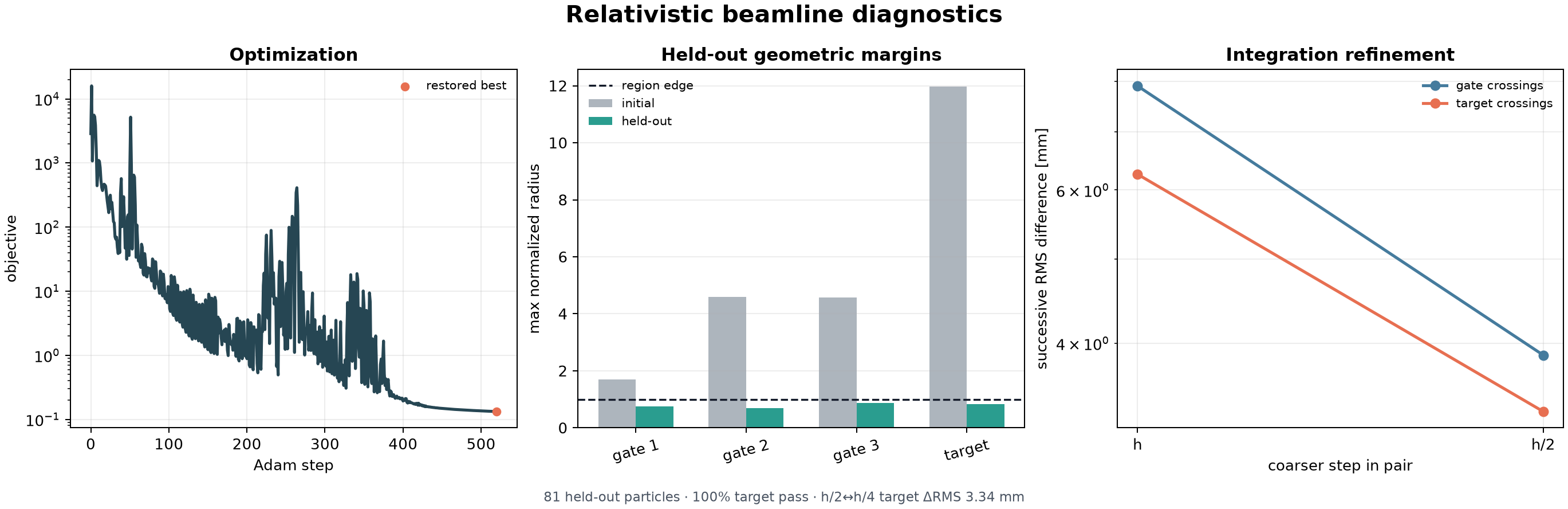
Eleven longitudinal control sites parameterize six field channels with local \(C^1\) cubic interpolation along the beamline. The optimization uses 25 particles. Its objective combines aperture and target geometry, focusing, direction and energy terms, forward-motion constraints, and compact field regularization. There are no separate centroid-equality losses for the intermediate apertures or target. Softened aperture and target-region penalties favor interior passage, while focusing, direction, and energy terms shape the downstream bunch. The region centers define those penalties, but gate and target centroid errors are diagnostics rather than acceptance limits. The softened penalties use normalized-radius limits of 0.92 at the gates and 0.88 at the target; acceptance checks require passage inside the actual unit-radius regions.
The restored field is then evaluated without retraining on an off-grid \(9\times9\) transverse phase-space grid containing 81 held-out particles. A separate \(h\), \(h/2\), \(h/4\) refinement study evaluates sensitivity to proper-time discretization.
| Quantity | Optimized / held-out result |
|---|---|
| Optimized gate max normalized radii | 0.687, 0.674, 0.682 |
| Held-out gate max normalized radii | 0.743, 0.687, 0.878 |
| Held-out target pass fraction | 100% |
| Held-out target max normalized radius | 0.829 |
| Held-out target RMS spread | 28.3 mm |
| Held-out target centroid error (diagnostic) | 25.2 mm |
| Held-out mean \(\gamma\) | 1.650 |
| Held-out mass-shell max error | \(4.8\times10^{-14}\) |
Successive crossing differences decrease under refinement. From \(h/2\) to \(h/4\), the held-out RMS change is 3.88 mm at the gates and 3.34 mm at the target. The refinement is reported as observed convergence behavior rather than as a formal convergence-order estimate.
Recorded default run summary:
setup         25 optimization particles | 11 field sites | 144 steps at h=0.042
[   0/520] loss=2.8683e+03 aperture=1.9907 focus=0.1556 gamma=1.539
[ 520/520] loss=1.3227e-01 aperture=0.0099 focus=0.0201 gamma=1.650
validation   81 held-out particles | target 100.0% | spread 28.31 mm | centroid 25.23 mm
refinement   target ΔRMS 6.26→3.34 mm | gate ΔRMS 7.90→3.88 mm
numerical    gamma 1.6498 | mass shell 4.8e-14
optimization best 1.323e-01 at 520 | final 1.323e-01
Run
Add --live for the interactive particle-bundle view. Saved artifacts are
written to outputs/relativistic_beamline_design/.