Layout, Storage, and TensorContract
A Clifford algebra with \(n = p + q + r\) generators has \(2^n\) basis blades. Most operations touch only a subset. A vector has \(n\) coefficients, a bivector has \(n(n - 1)/2\), and a rotor generated from a bivector occupies only even grades.
clifra makes this distinction explicit. A layout identifies which blades a tensor represents; storage determines how those coefficients occupy the final tensor axis; a tensor contract binds the two declarations together.
Basis and lane order
Basis blades use increasing bitmask order. Bit \(i-1\) denotes \(e_i\); the set bits give the ordered product of basis vectors. In \(Cl(3,0)\) the canonical order is
A compact layout retains this order after selecting grades. Lanes are not grouped by grade: a layout of grades 1 and 2 has order \(e_1,e_2,e_{12},e_3,e_{13},e_{23}\).
Layout is semantic structure
AlgebraSpec(p, q, r) fixes the signature and the canonical basis. A
GradeLayout then selects grades from that basis. From the specification and
grade set it derives:
- the number of active lanes;
- each lane's canonical basis index;
- a stable lane order;
- conversions to and from other layouts for the same algebra.
For \(Cl(8, 0)\), canonical storage has 256 lanes. A grade-1 layout has 8 lanes, a grade-2 layout has 28, and a layout containing grades 1 and 2 has 36.
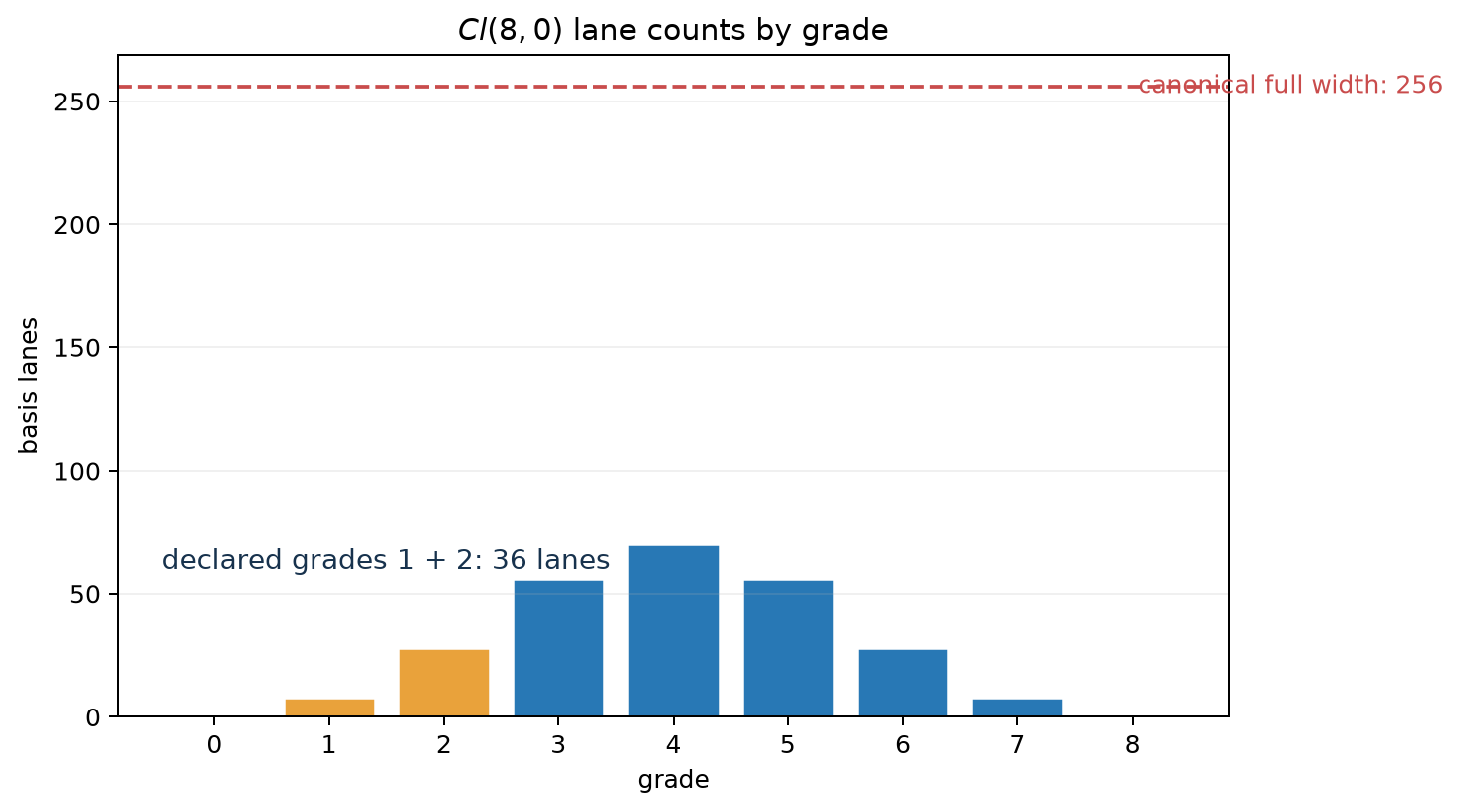
The layout is required semantic metadata. Two tensors with the same width can
refer to different blades, and their coefficient positions are not
interchangeable.
By carrying a GradeLayout, clifra can map through canonical blade indices
instead of assuming that equal positions have equal meanings.
import torch

from clifra.core import make_algebra

algebra = make_algebra(4, 0, device="cpu", dtype=torch.float32)
vectors = algebra.layout((1,))       # 4 active lanes
bivectors = algebra.layout((2,))     # 6 active lanes
both = algebra.layout((1, 2))        # 10 active lanes

v = torch.arange(4, dtype=torch.float32)
v_in_both = both.convert(v, vectors)
The conversion places vector coefficients in their matching canonical blade positions and fills the bivector positions with zero, preserving vector meaning instead of inferring it from a four-lane width.
Storage is the physical final axis
LaneStorage has two forms:
| Storage | Final-axis width | Meaning |
|---|---|---|
COMPACT |
layout.dim |
Only the selected layout lanes are present. |
CANONICAL |
2 ** n |
Every canonical blade position is addressable. |
Compact storage is the normal representation for narrow layouts. Canonical storage is useful at explicit boundaries, for a genuinely full multivector, or when interoperating with code that requires canonical blade positions.
A canonical-width tensor can still be interpreted through a narrow layout. In that case the layout remains the semantic declaration, and coefficients outside it remain outside the declared semantics unless the layout is changed explicitly. Width validation confirms the tensor size, but verifying that those outside-layout coefficients are zero requires a separate check.
TensorContract removes width ambiguity
A TensorContract combines three facts:
| Component | Question answered |
|---|---|
AlgebraSpec |
Which basis and signature define the coefficients? |
GradeLayout |
Which blades are semantically active? |
LaneStorage |
Are those blades compacted or placed in canonical positions? |
The resulting lane width is deterministic. Modules can validate a tensor at their boundary, convert storage deliberately, and preserve meaning through planned operations. A layout explicitly defines the geometric meaning; shape checking alone cannot determine whether six values are the bivectors of \(Cl(4, 0)\), the vectors of \(Cl(6, 0)\), or an unrelated feature axis.
Layout and contract helpers
The public helpers cover layout construction, lane lookup, conversion, and boundary validation. They remove the need to reproduce the canonical blade ordering in application code.
| Helper | Result |
|---|---|
algebra.layout(grades) |
A normalized GradeLayout for the algebra. |
layout.positions_for_grades(grades) |
Compact positions occupied by the requested grades. |
layout.indices_tensor() |
Canonical blade indices in compact-lane order. |
layout.grade_indices_tensor() |
One grade number for each compact lane. |
target.convert(values, source) |
Direct conversion between compact layouts, with missing target lanes set to zero. |
layout.compact(values) |
Selection of the layout lanes from canonical storage. |
layout.full(values) |
Placement of compact values into canonical storage. |
TensorContract.compact(...) |
A compact-storage contract for a layout. |
TensorContract.canonical(...) |
A canonical-storage contract with explicit layout semantics. |
contract.validate(values) |
Validation of the final coefficient axis. |
contract.to_compact(values) / to_canonical(values) |
Storage conversion under a fixed contract. |
positions_for_grades returns positions in compact storage, whereas
indices_tensor returns canonical blade indices. Use the former to select lanes
from a compact tensor and the latter only when a canonical index is required.
Tensor axes and composition
The final axis holds Clifford coefficients. Leading axes are ordinary tensor
dimensions. For a product, shapes [batch, 1, left_lanes] and
[channels, right_lanes] broadcast to
[batch, channels, output_lanes].
With pairwise=True, the penultimate axes are explicit item axes:
[..., L, left_lanes] and [..., R, right_lanes] produce
[..., L, R, output_lanes]. Remaining prefixes broadcast normally.
A layout passed to an operation declares compact storage. Use
TensorContract.canonical(layout) for canonical storage with that layout.
Omitted input declarations mean the full basis. Width validates a declaration;
the caller must select the layout and storage mode explicitly.
Compact tensors compose directly with PyTorch. Addition requires aligned lane
meanings; use target.convert(values, source) before combining different
layouts. Scalar multiplication and leading-axis reshaping preserve the layout
when they leave coefficient positions intact.
Storage and computation
Layouts describe static grade structure, independent of coefficient values. Products can exclude absent blades, impossible grade paths, and metric-zero interactions before execution. Compact storage remains a dense tensor with ordinary broadcasting and autograd.
Clifford algebra's combinatorial growth still applies. A request for all grades has \(2^n\) lanes, and a narrow output can require many input pairs. General bivector exponentiation may need a larger intermediate representation than its input. See Bivector Exponentials and Actions for the distinction between storing an exponential and applying its action.